



Here’s your chance to beat Andy Roddick at tennis…predicting. It’s really not that hard. During Served’s Roland Garros Bracket Challenge, 4,467 people outperformed him. We want even more Chuckers to bury him in Served’s first Wimbledon Bracket Challenge, so to help out, we asked previous Top 3 finishers for their strategies.
The Served Bracket Challenge is free to play. Brackets are due by the start of main-draw matches on Monday, June 29. That’s 11 a.m. in London, or 6 a.m. Eastern time in the United States. You can save your results and change your bracket until then.
Don’t Overthink the Early Rounds
The points structure in the Served Bracket is progressive, increasing by 10 for the first four rounds and 20 for the last three. What you get right in the Round of 16 and quarterfinals matters far more than what you nail on Day 1.
“Bracket challenges are not won on Day 1, so the focus is more on picking players who have chances to advance to the third or fourth round. There are many players who are consistent and have a track record of making the second or third round. “ —Henry from Roselle, Illinois
“My main rule of thumb? Never overthink the early rounds, because the tennis gods love destroying a perfectly logical bracket by day three.” —Steve from Chicago
Even though most points are available in rounds 1 and 2—640 points each—those toss-ups are harder to predict. That’s when you might use one player’s secret trick.
“A non-zero percentage of my picks were decided by who had the cooler kit or who I’d rather have a beer with.” —Steve from Chicago
Bonus Points Tip the Scales
The scoring system rewards two types of upsets:
Correctly picking an unseeded player to beat a seeded player doubles the round’s points.
Picking a lower seed to beat a higher seed yields a bonus equal to the seed difference (e.g., No. 20 beating No. 10 is worth an extra 10 points).
The unseeded bonuses are the bigger prize, and they can compound. An unseeded player who makes the fourth round could rack up 60 bonus points by taking out seeds along the way.
The Australian Open Bracket winner illustrated this perfectly, finishing with 186 bonus points, more than double what the second- and third-place finishers accumulated. The key was correctly predicting unseeded Wang Xinyu to upset two seeded players in the women’s draw.
“Since I’m from Hong Kong, I saw comments and discussions from Hong Kong and Chinese players about Wang Xinyu, which helped me successfully predict some of her upset wins.” —Gaile in Hong Kong
In the Australian Open contest, Andy’s seed bonuses (Victoria Mboko over Clara Tauson for +3 , Iva Jovic over Jasmine Paolini for +22) gave him the edge on JW.
The lesson: Look for one or two unseeded players with legitimate upset potential and back them to make a run, and target high seeds who are struggling for an upset.
Find Your Upsets in the Middle Rounds
A common bracket mistake is fixating on the winner while sleepwalking through the quarterfinals.
“In order to win, you need to have the players playing at the end. First-round upsets are great to have, but finding those milder upsets where players go multiple rounds is more important.” —Henry from Roselle, Illinois
This holds even more true when there is a runaway favorite for the title (Jannik Sinner). Everyone will have him at the end. Correctly picking a fourth-rounder, quarterfinalist or semifinalist that most others pass on can give you a bounce.
The reason Andy beat JW in the Australian Open women’s bracket is that he had a perfect fourth round. He nailed all the winners, whereas JW missed two. Those points, combined with his 25 bonus points from seed differentials, gave him 165 points more than JW, enough to overcome JW’s 104-point edge from picking the champion (Andy went with Sabalenka).
Remember the Best-of-Five Factor
The longer format changes the calculus for the men. Consider experience and fitness.
Use the Bracket’s Data Feature
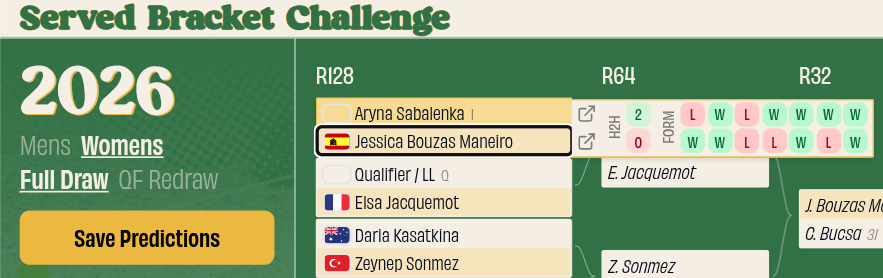
Served’s bracket has valuable data built right in. Hover over any match to pull up the head-to-head and each player’s seven most recent results. You can also hover over each match result to see the opponent, score and tournament. The square with an arrow next to the player’s name pulls up full results for the year.
If you can make an informed pick in a handful of matches, those wins can easily add up to an extra 100 or 200 points.
“When it comes to the later rounds, I do take into account matchups and head-to-head records. I also take into account performance on surfaces.” —David from Stamford, Connecticut
“How a player handles their last loss and their confidence level going into a major will factor heavily in my choices.” —Kris from Ruby, New York
A note on the form tool: Matches are listed from most to least recent, so interpret accordingly.
Watch for Withdrawals
Keep tabs on any late withdrawals and revisit your draw in case they change your choices. Otherwise, whoever takes that person’s spot in the draw will replace the pick in your bracket. This affected the Roland Garros Bracket this year. Arthur Fils pulled out at the last minute, and lucky loser Jesper de Jong took his place. Many Chuckers had Fils going deep—Kim even had him in the final. If they didn’t change their picks, they had Jesper de Jong going deep instead.
You can change your brackets up until the first ball—Monday, June 29, 11 a.m. London time, 6 a.m. U.S. Eastern time.
Note the Served House Rules
Qualifiers are good early-round picks. They are battle-tested and confident after three wins. If they are drawn against an opponent of a similar ranking, don’t assume the higher-ranked player is the favorite.
Getting Meddied is the new Cerundolo’d. Andy swore off picking Francisco Cerundolo after getting burned by him in the US Open Bracket Challenge. He’s over it, and now he’s wary of Daniil Medvedev. You have been warned.
Don’t pick against a Served or Love All guest before the third round.
Producer Mike’s Moneyball Method: picking whoever leads the head-to-head. What happens when there isn’t one?


There’s Time to Do Some Homework
It’s pretty hard to roll up to a Bracket Challenge cold and made a deep run. Cue up the Served and Love All tournament recaps to get your bearings. Our live-draw show has good intel on the nuances of grass and how they affect the draw.
“I try my best to follow results and watch highlights of the matches I don’t get to watch throughout the season so that I have a sense of who is playing well. Also, listening to the Served podcast every week definitely helps keep up with everything going on.” —Franco from New York City
The Redraw Is Just for Fun
You can redo your picks once we reach the Round of 16, but only your original picks score points.
Log In and Save Often
Make sure you’re logged in before you begin, or you will lose any selections. Also, save your Bracket as you work through it. The Save button is on the left side of the Bracket. Don’t wait until you’re finished to save. Technical errors happen.
The Bottom Line
Previous Served Bracket Challenge winners weren’t necessarily the most knowledgeable tennis fans in the field of 5,000. They were the ones who understood how points are actually earned—by surviving the middle rounds, chasing bonus points strategically and resisting the urge to play it safe when the scoring system rewards risk.
And every one of them said luck was a big factor. So pick your favorite player. Go with your gut. Back a dark horse. Take big swings. Good luck!
“My strategy was 40% tennis data and 60% pure chaos.” —Steve from Chicago

Hi,
I was just playing around the website and I clicked "discard local edits" thinking it could be reversible and now all my predictions are gone :(
Does this mean my bracket is completely gone and I am out of the challenge or is my bracket stored somewhere and can I reverse it?
Thanks for the help in advance :)
Hello,
I registered for the Served Bracket Challenge and completed both tournament brackets. However, today I’m unable to log in. I keep getting the following message:
“No user exists with this username or email.”
Could you please let me know where I can report this issue or who I should contact for support?
Thank you.